P. 9564

When we look up at the starry sky today, we can find all kinds of constellations. Sometimes with names that are easily understandable and sometimes with names that require a bit more imagination on our part. We can even see planets with the naked eye. Space travel made it possible to study celestial bodies more closely and to form a picture of their nature. Although the sky is well-explored today, it still fascinates us. And so, even today, the sight of the night sky almost automatically raises the question: Where does this all come from?
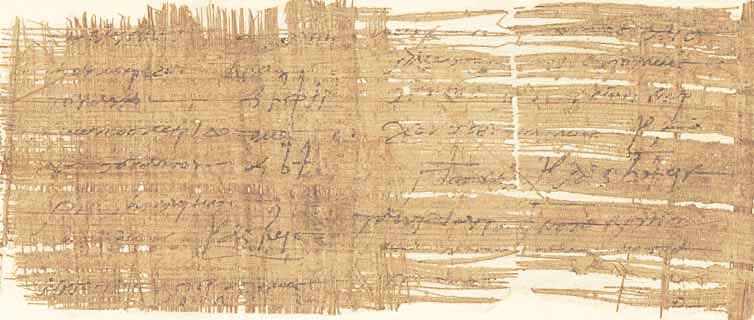
The papyrus presented here suggests that this idea was also on the minds of people in Egypt during the 4th century CE. Although it has survived only in a highly fragmentary state, the handwriting indicates that the text was composed during that period. Found in Eshmun, in Middle Egypt, it was purchased by Ludwig Borchardt in 1900 and entered the Berlin Papyrus Collection that same year.
The few words that can be read on it provide a clear indication of its content. Celestial bodies are mentioned: “Phaethon,” the radiating one, and “Phoibos,” Apollo in his role as the Sun. It also speaks of “Gaia,” the Earth, and “Erigeneia,” the “Early Riser”—the dawn—as well as the “Primordial” and the “blind night.” Clearly, our papyrus refers to celestial bodies and phenomena. The “Origin” and the “blind night” are concepts associated with the Greco-Roman conception of the creation of the cosmos.
People in ancient times attributed great significance to the heavens—stars have not only always served as a means of orientation in space and time, but were also used, for example, to create and interpret horoscopes, as is still done from time to time today. Astronomy was as much a part of education as music, sports, and rhetoric.
Ancient knowledge was often conveyed in poetic form. As early as 700 B.C., Hesiod provided the first traces of the great genre of didactic poetry within Greco-Roman literature. In addition to mythological material such as cosmogony or the genealogy of the gods, philosophical themes and worldviews were also explored. But more pragmatic knowledge—e.g., on agriculture, botany, medicine, or even recipes—was also conveyed in poems. Our papyrus here is written in hexameter—the classical meter of Greek and Roman poetry—and thus also belongs to this lyrical genre.
In antiquity, science was always embedded in religion: the cosmos—and thus all its natural laws—was of divine order. Educational texts today are written in a scientific manner, as neutrally and fact-based as possible—but for people in antiquity, an intertwining of knowledge, aesthetics, and faith was quite normal. There also was no clear distinction between astronomy and astrology. It is therefore hardly surprising that ancient scholarly literature often employed not only prose but also lyrical forms of expression.
It was customary for such works to begin with an invocation to the gods or the Muses. In the case of our papyrus, the author likely addresses his preface to the Muse Urania, whose domain is the heavens in the broadest sense: as the eldest of the 12 daughters of Zeus and Mnemosyne, she was revered as the Muse of astronomy and astrology. According to the Roman author Statius, she was also able to foresee the future through the arrangement of the stars—which reminds us that horoscopy was also an important part of astrology: People recorded the positions of the celestial bodies in the sky at the time of birth in horoscopes and sought to predict the fate of the newborn through their interpretation.
It is unclear to what extent the author of our papyrus actually referred to astrology in his poem, or whether it was more of an astronomical poem. However, the beginning of his text suggests that the creation of the world—or rather, the primordial state before the creation of the world—was the subject. It is about chaos—disorder and emptiness and the “origin” of everything. It is about the things that existed before everything else came into being, and in the fragment at hand, above all, about the things that were not yet.
5 “For before […] neither [… nor] […]”
(…)
7 “and not yet […]”
8 “nor did Phaethon himself [shine yet […]]”
The fragmentary verse beginnings are reminiscent of a passage from the beginning of Ovid’s Metamorphoses:
10 “Not yet did a Titan cast shining rays into the universe,
11 nor had Phoebus yet filled his horns with growth.
12 nor did the earth yet hold itself aloft by its own weight”
Ovid describes all that did not yet exist before the cosmic order came into being. It is likely that the author of the poem on our papyrus, following his opening, proceeds in the same manner as Ovid and describes how divine order emerged from this chaos: how the heavens and the earth were created, how the many stars and constellations were distributed throughout them, and how, ultimately, the structure arose that served as a compass and timekeeper for the people of antiquity and to which they attributed great religious significance.
The sky, like the gods themselves, was beyond reach. Incense and the smoke from sacrifices were always sent upward, toward the heavens. And people studied intently what they saw when they looked up—perhaps in the hope of catching a glimpse of a message or two from the realm of the gods.
