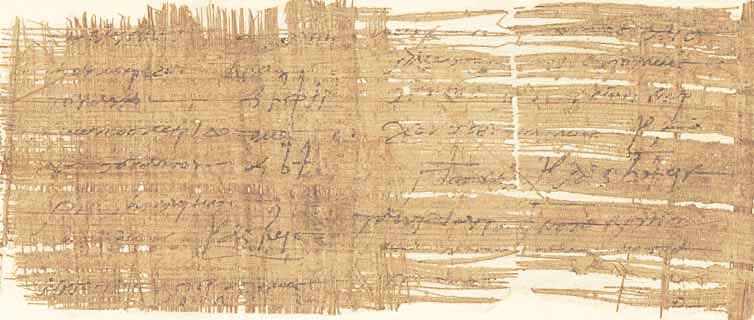
BGU II 647 (P. 6948 Kol. II)

Anyone who thinks bureaucracy is a modern invention has underestimated the Greeks and Romans. Almost 2,000 years ago, after a brawl, people didn’t just get back to their lives – instead, a doctor, village elder, scribe, and bailiff would arrive to meticulously document every scratch. One might almost think that the real injury wasn’t the skull fracture, but the paperwork. But behind this seemingly dry record lies more than just administration: it shows how astonishingly professional the work was, and how closely medical diagnoses were linked to law and state control. It is precisely this connection that makes the source so fascinating.
We learn very little from the official report from Roman Egypt about the actual fight: it took place five days before the investigation. A Mystharion was injured. His brother Petesuchos then filed a complaint with Protarchos, who held the office of strategos in the Herakleides district of the Arsinoites. The purpose of this complaint was less about the treatment and healing of the injuries and more about establishing whether any criminal offences had been committed and asserting claims against the perpetrators.
The present document is the official record of this investigation: it describes the medical examination of a man named Mystharion, who had suffered severe head injuries after a fight. A doctor examines the injured man, village elders confirm the findings under oath, a civil servant oversees the process, and a scribe records everything in writing.
Every step of the examination is carefully documented. The physician Gaius Menecius Valerianus describes the injury with great precision: above the left temple there is a deep fracture of the skull, and even small fragments of stone were found in the wound. This description is clearly not just for medical purposes. Rather, it is evidence for a later trial. The injury must be recorded as objectively as possible so that its severity cannot be disputed later. The physician is thus taking on a role that is surprisingly similar to that of modern forensic doctors. It is therefore not surprising that we learn nothing about the treatment of the injured man. Neither are there any descriptions of healing measures, nor any statements about the chances of recovery. The document’s sole interest is in the legally relevant determination of the injuries.
Equally interesting is the significance of the oath. The doctor and the two village elders swear by the Genius of Emperor Hadrian that their statements are true. This oath gives the document a special legal binding force, which is reinforced by more detailed descriptions of these three individuals. We learn that the doctor has a practice in the village of Karanis. The approximate age and distinctive physical features of the two village elders are specified. Both have scars on their shins or heads. These physical characteristics served for unambiguous identification, as there were no identity documents in the modern sense. The scars are, in a way, ancient identity cards.
The two village elders also fulfil an important function. They have no medical training and do not make a medical diagnosis. Nevertheless, they confirm that they have seen the same injuries as the doctor. Their presence increases the credibility of the examination. In a time when there were no photographs or technical examination methods, witnesses were essential. The combination of expert judgement and social confirmation greatly strengthened the evidentiary value of the document.
The role of the public servant also deserves attention. Herakleides organises the inspection, oversees its progress, and confirms its proper execution at the end. This shows how even local disputes were embedded in state administrative structures.
From today’s perspective, the combination of medical testimony, witness statements, oaths, and official oversight seems surprisingly modern. Many of these elements are also present in today’s legal system. Doctors still document injuries for court proceedings, witnesses confirm observations, officials oversee procedures, and written records form the basis of legal decisions. Of course, the legal and scientific standards are very different, but the basic idea of a traceable chain of evidence connects the ancient and the modern.
