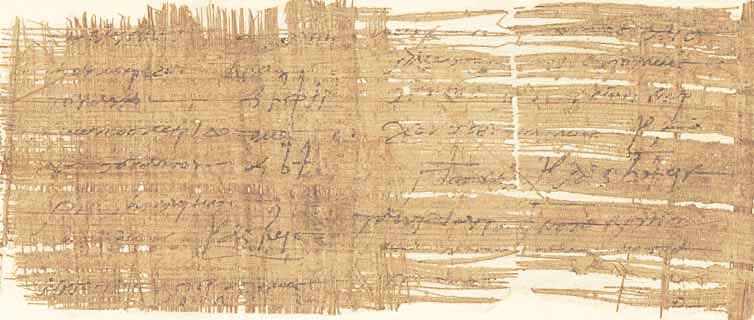
BKT X 26 (P. 7977)

Today, anyone suffering from fever or pain usually relies on modern medicine. However, looking back at late antique Egypt in the 4th or 5th century AD, we encounter a completely different concept of healing. In an era when illnesses were often understood as the work of „unclean spirits“, the line between medicine and magic was blurred. People sought help in so-called iatromagic, a healing art that employed the written and spoken word as a powerful weapon against suffering.
A particularly fascinating piece in the Berlin Papyrus Collection is this small parchment, which originates from the Fayum region. It reveals not only the fears of people from over 1000 years ago but also offers a rare glimpse into the knowledge of ancient healers.
The physical nature of the object is remarkable in itself. The original sheet was approximately 7 x 11 cm, but its condition upon discovery suggests a significant ritual act: it was folded horizontally inward seven times and then folded vertically multiple times. The result was a tiny, firm packet measuring just 0.8 x 1.3 cm. This so-called “περίαπτον“, worn around the person, was designed to be carried close to the body. Perhaps it was sewn into a garment or worn around the neck. The folding likely served not only for convenience but was intended to seal the magical power of the text within, surrounding the wearer like a protective shield.
The text itself is written in a Greek that presents us with several puzzles today. It begins with the words “βιβίου βιβίου σφη νοση“. These unintelligible sequences of words, were understood in antiquity as a kind of divine code. They were meant to draw the attention of supernatural powers and bolster the authority of the incantation.
Furthermore, the scribe appears to have worked somewhat carelessly. An amulet usually consists only of the actual spell, the logos (λόγος). In this case, however, he copied not only the incantation from his handbook but also the accompanying instructions, the praxis (πρᾶξις). Thus, on the parchment, one reads the instruction to write the inscription on a small piece of papyrus and bind it around the sufferer. It’s almost as if a modern pharmacist had printed the medication’s package insert directly onto the pill.
This becomes particularly clear in line 4: In the original, there is no name, but only a delta with a vertical stroke (δ). This is a classic antique abbreviation for the word “δεῖνα“, which means „N.N.“ or „insert name here.“ The scribe simply and stubbornly copied this placeholder from his handbook instead of inserting the actual name of the patient. The fact that the amulet was still folded and obviously used suggests that either the template was not fully understood or the exact wording of the manual was attributed such great power that even the placeholder was considered to have healing properties.
In terms of content, despite its magical formulas, the amulet is also rooted in a Christian worldview. With the command anachorei (ἀναχώρει)—“Depart!“—the illness is directly addressed as a demon and asked to leave the creation of God. This occurs within an exorcistic context—meaning within the framework of a ritual expulsion of evil powers believed to have possessed a person. Healing is thus depicted in a way that the demon has no right to occupy a creation of God “πλάσμα“. Whereas exorcism is understood as the ritual expulsion of demons and evil powers that are believed to have taken possession of a person.
Therefore, this parchment is far more than just a simple object, rather, it serves as a link between humanity and the hope of healing through magic, in the form of a folded protective shield against demons.
