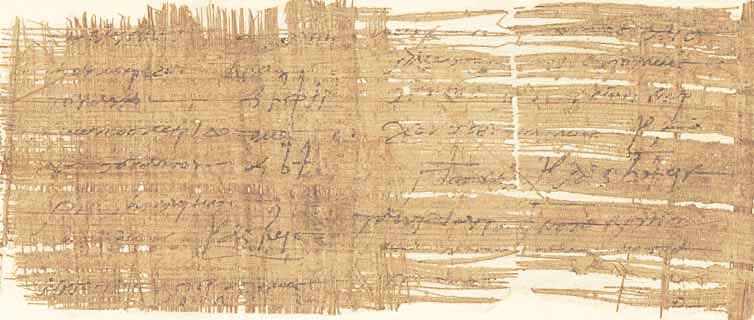
BKT X 29 (P. 11831)
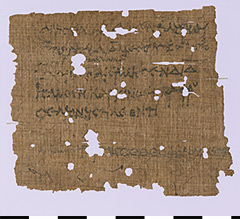
This small slip of papyrus, comfortably held in the palm of a hand, holds in its early date an outsize importance for the history of the astral sciences. It proves to preserve the earliest textual horoscope in Greek in the papyrological record and also holds some peculiarities in tow.
The text appears to be complete, although there is practically no right margin. The papyrus has been recycled. Below the last line of the text clear traces of one line of older writing are visible. This text is written in a paler ink but in a style roughly contemporary with that of the horoscope. The hand is quite different and forms regular, round and well-separated letters, resembling those of literary texts. The writing seems to continue past the right edge, which could suggest that the slip was cut from a sheet or roll already used for another text.
To some extent the text of the horoscope is quite typical for an ancient horoscope. Contrary to what one might expect from the modern horoscopes familiar from news media and smartphone apps, the astral data are at the center, and no accompanying analysis is included. Any analysis would apparently have been delivered separately: in the case of most ancient horoscopes, perhaps reserved for an in-person consultation between a professional astrologer and a client.
But this horoscope also differs from other ancient “original” horoscopes. Unusually, it bears no personal name, or other indication that it charts the astral data for a birth in particular, and no date. One wonders, then, what kind of a horoscope it was. For another Berlin papyrus with a horoscope, similarly missing a personal name and explicit identification as a birth-horoscope, it has been argued that the function was a draft for monumental purposes, to adorn a funerary monument with a depiction of the sky at the birth of a deceased person. A birth-horoscope remains the most likely here, but other life events, as recorded by authors on astrology like Vettius Valens (second century CE), remain possible.
In the case of the horoscope discussed here, it has been proposed, the slip may constitute private notes kept by either the professional or the client. Abbreviations for some of the names of planets and zodiac signs—Gemini and Venus, for example, are written with the equivalents of Ge and Ve—also support a context of use by relatively more experienced writers, assuming readers who could work out how to expand these abbreviations from familiarity with the genre. Positions, as in most original horoscopes, were given only in whole zodiac signs, without the added specification sometimes found in degrees. The Moon, for example, with which the list ends, stood in Leo. Additionally, the zodiac sign on the horizon, the “ascendant” or horoskopos in Greek, which provides the name of horoscopes as genre, is noted, and a counterpart point “midheaven” (mesouranēma) corresponding to the highest point reached by the Sun in the sky on the day in question.
The text does not note the date of the event for which the positions were computed, nor does it mention a date of its creation. Paleographically the text can be dated to the late Ptolemaic or early Roman period. If this is combined with a re-computation of the positions described in the text, a moment at about 3 AM on 5 June, 29 BCE, gives the best fit for the positions of the planets, but not without error: the Sun would have been in an entirely different sign, Gemini, than the one indicated by the papyrus (Cancer).
Perhaps also connected to its early date, the papyrus does not list the planets according to the ordering principles (geocentric distance, or order of the zodiac signs) that came to dominate in later papyrus horoscopes. This is one more sign of its exceptional witness to the early days of horoscope astrology in Greek in Egypt.
