SB XIV 11658 (P. 13232 V)

A 1,400-year-old papyrus fragment from Egypt contains only a few words – but they are significant. Between oracle tradition, Christian piety and magical practices, the text defies any clear interpretation. The unassuming papyrus fragment raises big questions: Is its brief Christian text the answer of an oracle, a personal protective amulet or something else entirely? The search for clues leads from ancient temples through Byzantine magic to the boundaries of modern research.
Foreign rule over large, culturally diverse areas through distant powers necessarily leads to political, religious and cultural conflicts. At least the religious aspect did not pose too big of a problem in the time of ancient conquests. Polytheistic cults can easily be expanded, similar gods be combined or swapped out. It became more difficult after emperor Constantin converted to Christianity. Most elements of the prior faith and religious practice now stood in direct conflict with the state religion of the large Roman Empire. The oracle is one of the pagan practices which were continued in adapted form.
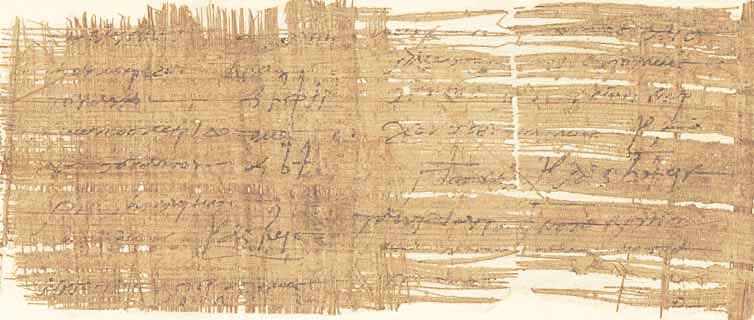
One side of the berlin papyrus P. 13232 was first published in 1976 by K. Treu as one such „Christian oracular answer“. The object was excavated in 1905 in Hermupolis (the modern day Eschmunen), under leadership of Otto Rubensohn. It has writing on both sides: on one side only 2 incomplete lines of a document are preserved, on the other side 3 complete lines, in front of which stands a cross.
The complete text on one side with a fragmentary text on the other implies that the latter was written first, with a cutout of its papyrus then being used for this magical text, which would also date this one at around the same time or later.
The 2 cut-off lines on the recto are written in a cursive, elongated style of the 6th and 7th centuries, as was the standard for documentary texts. It was written transversa charta (the papyrus was turned by 90 degrees before writing). The large gaps between the lines were kept rather imprecisely, though there is an empty section, the size of the gap between the two lines, at the bottom of the fragment, which implies that this is the lower ending of the original papyrus. The short text has not yet been published, but due to the small number of preserved letters does not allow for any major conclusions. The Christian-byzantine dating is mostly based on palaeographic characteristica of that time and the cross in front of the first line of the verso.
The text on the verso
1 μὴ βλάψης τὴν
2 ψυχήν σου ἐκ θ(εο)ῦ
3 γὰρ τὸ γενάμενον
can be translated in English as „Do not harm your soul. For what has happened is from God.“ (G. H. R. Horseley)
Oracular texts of pagan times, formulated as conjunctive questions for gods, were usually written on previously unused papyri, whereas this reused object would have already had text on the other side.
In the so called „ticket oracle“, two possibilities were written out on separate papyri, usually describing one positive and negative of a certain conjugation. These were then given into a temple and, after a still unknown procedure, the asking person was given back one of these papyri as the answer.
In pagan times these texts were formulated in the style of a letter, in which the god was first addressed, then a conjunction was posed and lastly stood the wish for the return of this papyri, in case of its correctness. In oracular papyri this was a uniform system which stayed fundamentally the same for more than a thousand years and was therefore presumably subject to common principles, based on which texts were homogenized by the scribe. This text here does not follow that structure and its impreciseness makes it difficult to see it as one of two possibilities. Oracular texts from byzantine times are much rarer, even with the continuation/rediscovery within Christian practice. The five other texts which have been published as such continue the pagan form of the oracular question.
In comparison with other Christian texts this text would therefore most likely be prescribed this one as either a prayer, a spell or an amulet. Though in these categories it also would not have any clear formal or textual equivalents (texts are usually longer, more specific) and it would thereby also be difficult to Interpret from this context. The possibility of the text as a pure prayer or amulet was already posed by Lucia Papini.
According to H. R. E. Horsley the preservation of this object speaks for a possible strong personal meaning to its recipient, for example as an amulet. This would probably generally apply more to objects that contain phrasing of religious origins, instead of, as was the case with ticket oracles, simply being prescribed additional meaning through official religious practice. Though the object does not display any signs of folding as they would be typical with amulets.
The textual translation is clear, the theological interpretation on the other hand is more challenging. The single cross is used here in a typical manner at the beginning or of surrounding texts or sections of text. The other common form of use is a collection of 3 crosses standing next to each other, usually at the end. Though this form was most commonly used for curses, which can already be ruled out as a possibility for this text.
The writing style of the cross in Christian texts overlaps in its evolution with general Greek palaeography. The elongated lettering leads to more asymmetrical crosses, who’s planks are extended horizontally or vertically, which leads to a similarity of written crosses from the 6th to 7th century with the Latin cross (crux immissa). As one of the few examples of a cross written in an uncial text from after the 5th century this one would contradict the general development, as it looks quite symmetrical, which means that this development probably cannot be prescribed any general stylistic meaning for textual depictions of the cross.
Amulets were frequently equipped with biblical citations and phrasing. I could not find an exact source for this text. The most direct similarity exists with some psalm beginnings (25, 38). The imperative form of the verb implies an orderly prayer to the addressee. The context might have been spiritual or mental illness, for example as part of an exorcism.
The exact function of the object remains unclear. The Berlin papyrus fragment P. 13232 does not fit into any known category. Therefore, this mysterious text offers fascinating insights into the religious praxis between Christianity and ancient magic. Neither as part of an Oracle, nor as an amulet or spell does it comply with categorical norms. Therefore, I would only prescribe it as a Christian magical text, which might have had its meaning between or outside of these categories.
