BGU I 304 (P. 2547)

In ancient times, Egypt was considered the ‘granary of Rome’ because the fertile Nile plains provided a large part of the grain supply for the Roman Empire for centuries. Bread was a central staple food. There was an impressive variety of bread types. The papyrus presented here addresses this topic, but not in terms of different types of bread, but rather an exceptionally large quantity of bread.
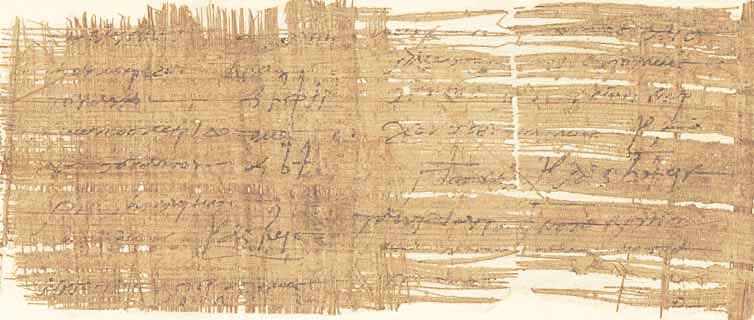
The document is a contract that also serves as a receipt for a large quantity of grain. In it, a man named Elias from Heracleopolis confirms that he has received a large quantity of grain from his client Flavius Christophorus, the equivalent of about 600 kilograms. In return, he undertakes to process the grain into small loaves of bread at the client’s request and to return it at a later, unspecified time. Flavius Christophorus, the client, held the office of pagarch, a high administrative position directly below the provincial governor. He did not conduct the transaction personally, but had it carried out by his administrator Cosmas.
Cosmas probably wrote the majority of the contract. His handwriting is practised and quick, characterised by numerous abbreviations, which makes the text more difficult to decipher. Elias’s own signature is quite different. His handwriting is less developed; he uses only capital letters, makes a conspicuous spelling mistake and, due to lack of space, has to arrange his name in an unusual way on the edge of the papyrus: he piles the letters of his name up in an adventurous way. Nevertheless, his signature shows that he was able to write – a skill that was by no means self-evident for someone in his profession.
Another person who appears in the contract is the notary Anoup. He signs the document at least twice, each time with his name, a formula of affirmation, and his professional title as a contract writer. Notably, he writes his name in both Latin and Greek, but in both cases in Greek letters. Both Flavius Christophorus and Anoup are known from other papyri from the same region. This allowed historians to precisely date the document: to the 21 November 647 AD.
This dating coincides with a time of major political changes. The Byzantine rule in Egypt had just been replaced by the Arabs. This change is reflected in the contract: At the end, there is no religious or imperial oath, as was customary before. Instead, there is only a simple affirmation formula: ‘I, Elias (…), stand by my word.’
However, some questions remain unanswered and will probably never be answered: Why is no amount of money mentioned in a transaction of this size? And why does a high-ranking official need such a large quantity of bread at an unspecified time? The text itself does not provide any answers. It is possible that the bread was intended to feed soldiers on a campaign. It is also possible that it was for a public meal or a large celebration. In the end, the exact use of the bread is speculation – but the papyrus provides a fascinating insight into administration, economy and everyday life in 7th century Egypt.
