BGU I 266 (P. 7107)

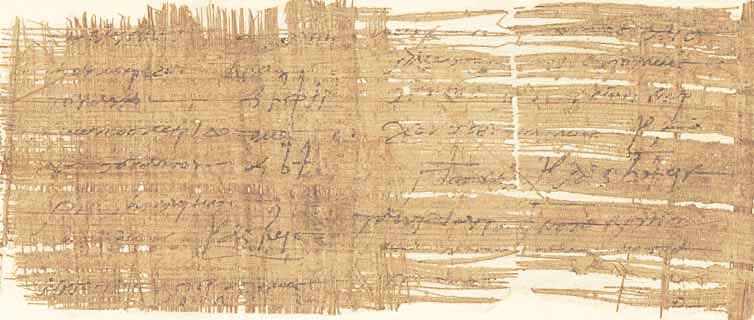
When Emperor Caracalla went to war against the Parthian King Artabanus IV in 216 AD, he needed not only soldiers but also animals for the cavalry and transporting heavy loads. The Roman army resembled a traveling small town and, in this case, consisted of eight legions of approximately 5,000 men each, accompanied by numerous auxiliary troops and tens of thousands of (pack) animals in the supply train. This papyrus offers a fascinating glimpse behind the scenes of this logistical feat; it tells the story of a camel (actually a dromedary) that, some 1,800 years ago, embarked on a long “mission” as a pack animal from Fayum in Egypt to the Parthian Empire on behalf of the Roman imperial family.
The mention of Soknopaiou Nesos (today’s Dimeh es-Seba) allows us to pinpoint its origin in this Egyptian town located on the edge of the Fayum Basin. It was a settlement on the shore of Lake Qarun, dominated by a massive temple dedicated to the crocodile-like deity of the same name.
In the Egyptian administrative system, there was an annual requirement to submit a declaration of current holdings (ἀπογραφή) to the relevant authority, which was used, for example, to calculate the tax due. These declarations could pertain to real estate, the number of people living in the household, or livestock ownership. Since the drier region around Soknopaiou Nesos, in contrast to the more fertile Fayum Basin, was less suitable for agriculture and more for livestock raising, camels were the primary animals kept there. The majority of the 47 camel declarations still preserved today come from this very location, with an average of 3.7 animals per declaration.
An Egyptian woman named Aurelia Taesis appears in the papyrus as the one who had declared her property, consisting of two camels, for the previous year, 215/216 CE. Since women were not permitted to submit the declaration themselves, she was represented by a male guardian. Although his name has not been preserved, the patronym Pasoknopaios (“The one from Soknopaiou” or “Servant of the god Soknopaiou”) suggests that he, too, was a local Egyptian. The letter is addressed to two persons of the administration of the northwesternmost of the three Arsinoite administrative units (Fayum), the Heracleides district, the governor (στρατηγός) Aurelius Dionysios and the royal scribe Aurelius Isidotos.
What is striking is the peculiar prevalence of the essentially Roman nomen gentile “Aurelius/a.” This anomaly can be attributed to the power behind the scenes: the Roman imperial house, more specifically, the North African-Syrian Severan dynasty under Caracalla (211–217 CE). In this papyrus, the emperor not only appears as the driving force behind the events but is also directly involved in the naming of the individuals mentioned, through the Constitutio Antoniniana he issued in 212 CE. According to this decree, the aim was for all free inhabitants of the empire to obtain Roman citizenship. This initiative resulted in one of the most significant waves of naturalization in human history, during which nearly 30 million people got new rights and given the name of the imperial family. In this case, “Aurelius/a,” derived from Caracalla’s imperial name, “Marcus Aurelius Severus Antoninus.” The edict also enabled the emperor to more easily incorporate these “newly acquired” citizens as urgently needed legionaries into his war preparations against his great enemy in the East.
According to ancient sources (Cassius Dio, Herodian, and the Historia Augusta), Caracalla had already made a futile attempt in 213 CE to instigate a war in the looming fratricidal conflict between the reigning King Vologases VI and Artabanus (IV) over Parthian rule. He then dethroned the neighboring Roman vassal kings of Armenia and Osrhoene in order to militarily strengthen their lands as official Roman provinces. During his visit to Egypt in the winter of 215/216 CE, as the present papyrus indicates, concrete plans for the upcoming military campaign likely played a role alongside the veneration of Alexander the Great and the god Serapis, as well as the possible massacre in Alexandria. The papyrus reports that, for this purpose, the two camels belonging to Aurelia Taesis were first used for the festivities surrounding the emperor’s visit, then returned home, and were finally requisitioned again. A centurion of Legio XVI Flavia Firma, Aurelius Calvisius Maximus, selected the animals with the permission of the Roman prefect of Egypt, Valerius Datus. Upon examination of the camels, however, only one was deemed suitable for the upcoming hardships; the other returned home.
The fact that, in the end, only one camel remained as provisional property is certified by the authorities at the end of the papyrus and dated (5 Mecheir = January 30). As was typical for such declarations, this one was carried out at the beginning of the sixth Egyptian month, Mecheir (late January). What is particularly noteworthy is that the notation was later crossed out by a third party with the addition, “I have deleted (the entry).” One can only speculate as to the reasons for this, such as to prevent misuse. It is also interesting to note that this document represents the last surviving camel declaration. Why the record ends here is likewise unclear. Another mystery remains: what happened to the camel that initially traveled the long distance to the province of Syria, only to continue from there as a pack animal in the campaign against the Parthian King.
The course of the war itself initially looked promising for the Roman side, and the conquest of the provincial capital Arbela (today’s Erbil), along with the plundering of the royal necropolis, marked an early high point. However, the fighting came to an abrupt end on April 8, 217 CE, with the assassination of Emperor Caracalla by his own soldiers and the payment of enormous reparations to the Parthians by his successor, Macrinus. Whether our camel survived the turmoil of war and whether it managed to make the long journey home from its “mission” back to the shores of Lake Qarun will, as mentioned, remain a mystery; yet it is clear that a simple declaration has much more to tell than it initially appears.
